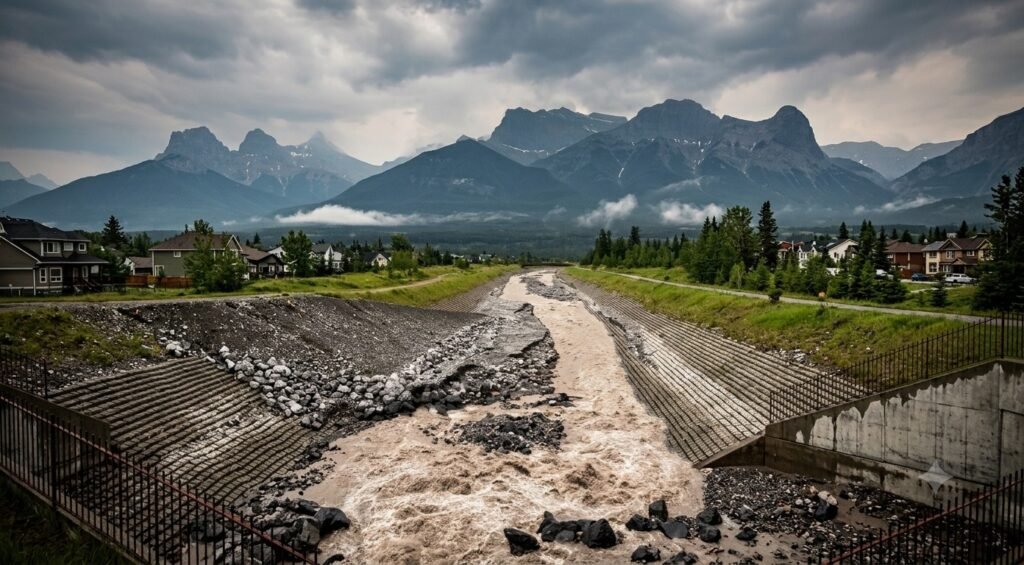
If you spent the last 48 hours huddled inside listening to the continual sound of rain against your windows, you aren’t alone. For most people, a long, steady rain means nothing more than an excuse to brew an extra cup of coffee, grab a heavy blanket, and cuddle up on the couch.
But here in Canmore, a storm that lasts for days is rarely just “weather.”
As the rain continued to fall over the weekend, the collective anxiety across the Bow Valley became palpable. For anyone who lived through the floods of June 2013, the sound of water rushing down steep mountain creeks isn’t just background noise—it can be a powerful emotional trigger.
A Quick Grounding Moment: Look Around You Right Now
If your heart rate spikes every time you look out the window, pause for a moment and try this grounding technique to bring yourself back to the present:
- Acknowledge the memory: Remind yourself, “2013 is a memory. It lives in the past. It is not happening right now.”
- Look at your immediate surroundings: Notice the sturdy walls around you, the dry floor beneath your feet, and the safety of your current space.
- Remember our strength: Remind yourself that we are exponentially safer today than we were over a decade ago. Since 2013, millions of dollars have been invested into massive, engineered flood mitigation measures and debris barriers across the Bow Valley to protect our homes.
We aren’t caught off guard anymore. Today, we have direct communication lines. Emergency text alerts keep us updated in real-time, giving us the power of information right in the palm of our hands.
Good to know for our mountain neighbors: Local emergency text alert systems aren’t just for Canmore. The Town of Banff and the MD of Bighorn both use the Voyent Alert! app system, and you can even drop a pin for Lake Louise within it to receive critical updates from Parks Canada. If you haven’t signed up yet, it is a quick, free way to trade anxiety for peace of mind.
Echoes of 2013
For many, seeing the Bow River rising and a state of local emergency declared brings us back to thirteen years ago. In 2013, a catastrophic combination of an intense weather system and rapid mountain snowpack melt brought over 220 millimetres of rain in just 36 hours. Cougar Creek became a raging torrent of boulders and trees, completely shifting the landscape of our town. Roadways and homes were severely damaged, and our entire community was put on high alert.
For me, that flood took more than just property. At the time, I had stored all of my son’s childhood artwork—from ages 2 to 6—in our crawlspace. Losing those irreplaceable memories to the muddy floodwaters was the most devastating part of the experience. The furnace replacement that followed was just “stuff”—expensive and stressful, yes, but ultimately replaceable. The loss of those little finger-painted masterpieces, however, still stings.
When a new weather system hits bringing severe rainfall warnings, localized flooding, and high streamflow advisories, those old memories naturally want to resurface. However, it is important to recognize when our caution turns into hypervigilance. Compulsively checking for news on TV and social media won’t calm your nervous system.
Instead of letting those old memories control our actions today, we can consciously choose to step back. We can trust the modern emergency alert systems to notify us if anything changes, look out our windows to see that we are currently secure, and remind ourselves that we are living in the present moment—not in 2013.
If the recent rain has triggered a level of hypervigilance or anxiety that feels difficult to manage on your own, please know that support is available. You don’t have to navigate these heavy moments alone. To learn more about local anxiety counseling or to speak with a Canmore psychologist, please feel free to reach out to our team at the clinical practice.